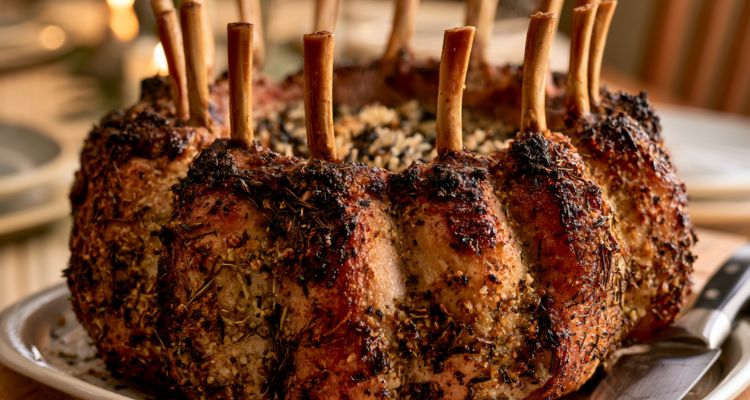
Martha Stewart’s crown roast is a pork rib roast rubbed with orange zest, garlic, and rosemary. It starts at 220°C (425°F), drops to 190°C (375°F), and takes about 1 hour 45 minutes total. The pan juices make a gravy with white wine and apple cider.
This recipe first appeared in Martha Stewart Living, January 2001. Stewart pairs it with a wild rice dressing spooned into the crown’s centre after resting. Her gravy uses a butter-flour paste whisked into the reduced juices, not a roux started separately.
The key technique is two-stage roasting: 15 minutes at high heat, then a drop to 190°C (375°F). Stewart insists on several thermometer readings around the crown because thickness varies between ribs. One check won’t tell you if the whole roast is cooked through.
Martha Stewart Crown Roast
Course: DinnerCuisine: AmericanDifficulty: Easy18
servings20
minutes1
hour45
minutes300
kcal2
hours5
minutesA whole pork crown roast with an orange-rosemary rub and a pan gravy built from wine, cider, and stock, from Martha Stewart Living (January 2001). Ask your butcher to remove the chine, feather bones, and excess fat.
Ingredients
- For the roast:
1 crown roast of pork, 3.6–4 kg (8–9 lb), chine and feather bones removed
salt and freshly ground pepper
80ml (5½ tbsp) olive oil
grated zest of 1 orange
4 large garlic cloves, finely chopped
2 tablespoons chopped fresh rosemary
- For the gravy:
180ml (¾ cup) dry white wine
120ml (½ cup) fresh apple cider
240ml (1 cup) chicken stock
15g (1 tbsp) unsalted butter, at room temperature
2 tablespoons plain flour (all-purpose)
salt and freshly ground pepper
- To serve:
wild rice dressing (see Stewart’s linked recipe on marthastewart.com)
Directions
- Preheat the oven to 220°C/425°F/Gas 7. Position the rack in the lower third. Brush the roast with 60ml (4 tablespoons) of the olive oil and season with salt and pepper.
- Combine the orange zest, garlic, rosemary, and remaining olive oil in a small bowl. Spread the mixture evenly over the meat, inside and out. Place the roast in a heavy-duty roasting tin on a rack large enough to hold it.
- Roast for 15 minutes. Reduce the heat to 190°C/375°F/Gas 5 and continue roasting, rotating the tin after 45 minutes. The meat is done when well browned and an instant-read thermometer reads 65°C (150°F). This takes about 1 hour 30 minutes. Take several readings around the crown, avoiding the ribs, to check the temperature is even.
- Transfer the roast to a board with a well and rest for 20 minutes. Raise the oven to 220°C/425°F/Gas 7 if baking the wild rice dressing at this point.
- Pour the pan juices into a fat separator or glass jug and leave for 5–10 minutes. Remove the fat, then return the defatted juices to the roasting tin. Set the tin over medium-high heat on the hob, add the wine, and bring to the boil. Scrape up any brown bits with a wooden spoon and boil until half the liquid has evaporated, about 5–7 minutes.
- Stir in the apple cider and stock, season, and bring back to the boil. Mix the butter and flour together in a small bowl until smooth. Whisk this paste into the tin and keep whisking until the gravy thickens slightly, about 4–5 minutes. Strain into a gravy boat.
- Place the roast on a serving platter, spoon the wild rice dressing into the centre if using, and carve at the table.
FAQs
How long should I cook a crown roast per kilogram?
Allow about 25 minutes per kilogram at 190°C (375°F) after the initial 15-minute sear at high heat. A 4 kg roast needs roughly 1 hour 40 minutes total. A smaller 3 kg crown might be done in 1 hour 15 minutes, though oven calibration and starting temperature both affect timing.
The thermometer is what actually tells you it’s ready. Pull the roast at 65°C (150°F) because the temperature climbs another 3–5°C during the 20-minute rest. I found the bones conduct heat unevenly, so checking one spot between two ribs isn’t enough.
Should I cover the bone tips with foil?
Stewart doesn’t mention this, but the exposed rib tips sit in a hot oven for nearly two hours and can char badly. Wrapping the top 3–4 cm of each bone in foil before roasting stops them from blackening. Remove the foil in the last 15 minutes if you want a bit of colour.
Some cooks skip the foil and fit paper frills onto the bones after carving instead. The foil method is more practical because it also means fewer burnt fragments in the tin when you’re building the gravy.
Can I prepare a crown roast the day before?
You can rub the meat with the orange, garlic, and rosemary mixture up to 24 hours ahead. Cover tightly with cling film, refrigerate, and take it out 1 hour before cooking so it reaches room temperature. The overnight rest lets the aromatics penetrate deeper into the pork.
The gravy can’t be made ahead because it depends on the roasting juices. You can prepare the butter-flour paste in advance and keep it in the fridge, ready to whisk in. If you’re making the wild rice dressing, cook it the day before and warm it in the oven while the roast rests.
How do I carve a crown roast?
Stand the crown upright on a board and slice straight down between each pair of rib bones. Each chop has one bone attached. A sharp carving knife makes this easy because the chine bone is already gone, so nothing connects the ribs at the base.
From a crown with 16–18 ribs, each of the 18 servings gets one chop. If your crown has fewer ribs, cut boneless slices from the thicker sections to make up the numbers. Serve each portion with gravy and some of the wild rice dressing alongside.
What’s the difference between Stewart’s two crown roast recipes?
The marthastewart.com version uses orange zest with garlic and rosemary, and includes a pan gravy thickened with a butter-flour paste. It calls for a single pre-formed 8–9 lb crown roast and first appeared in Martha Stewart Living, January 2001.
The PBS Cooking School version from her “Perfect Roast” episode is different. It uses lemon zest with parsley and sage, starts with two separate racks you tie together yourself, and skips the gravy entirely. The PBS version suits cooks who want more control over assembly, while the magazine version is better for a holiday table.
What sides work best with a crown roast?
Stewart’s own pairing is wild rice dressing, and it works because the nutty, chewy grain contrasts with the tender pork. Roasted root vegetables are another strong match. Parsnips, carrots, and sweet potatoes roasted at 200°C with thyme take about 40 minutes. For something lighter, a green bean salad dressed with lemon cuts through the richness.
For a roast with a different protein, Jamie Oliver’s steak method uses a similar high-heat sear followed by resting. And his jacket potato method gives you a crisp skin that holds up well next to gravy.